Louisa Lawson – the full picture?
As readers, and as writers, we are drawn to words on the page. And why not? A good book can transport and transform.
But pictures, we are told, can tell a thousand words. Maybe so. Do the extant photos of Louisa Lawson always give us the full picture? Sometimes what is left out of an image can tell us a great deal too.
Consider the way published images from the battlefields of WW1 rarely included the dead or injured. Fifty years later, the published images from the battlefields of Vietnam were much more graphic. Was the difference due to changes in public sentiment about the nature of war? Or did seeing those graphic images from Vietnam actually change public sentiment?
The answer: well, it’s complicated.
As a researcher I’m certainly beginning to learn that the images held by an archive are often just as valuable as the words. And, fortunately, Louisa Lawson’s archive in the Mitchell Library contains a wealth of images.
Here’s a telling example. In the image below you can see Louisa Lawson in 1870, aged 22, standing beside her second son, Charles. The photo shows us a great deal about her living conditions; about how the dwelling was constructed; about what she and infant Charles wore. Louisa’s eldest son Henry, not in this photo, would have been about three.
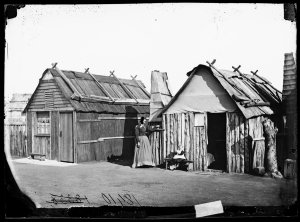
Perhaps you’ve read a short story called ‘The Drover’s Wife’ written by that eldest son (albeit not when he was three). If so, the hut might seem familiar. Henry Lawson’s many biographers argue that the title character of ‘The Drover’s Wife’ was very much based on his mother, and on Henry’s own upbringing in an isolated bark hut.
The truth? Well, it’s complicated.
The family had moved from that rough hut into the neat cottage below, in Eurunderee, shortly before Louisa’s third son, Peter, was born in 1873. That is, when Henry was five or six. This was the cottage, on 40 and later 80 acres, that Louisa Lawson and her family lived in for the next decade. The photo below is of the tin-roofed farm house where Henry Lawson grew up.

Well, I hear you complain (and with some justification) that doesn’t mean anything. A writer like Henry Lawson can certainly draw on his isolated early childhood in a bark-roofed hut.
And, yes, of course he can. I wholeheartedly agree.
But let’s look at a third photo, which seems to have been taken on the same day in 1870 as the first one. Now we can see that the family’s bark hut is one of a cluster of buildings, and that Louisa’s sister Phoebe has optimistically set up shop next door.
The State Library’s website allows you to zoom right in, giving an excellent view of the women’s clothes (Louisa Lawson’s skirt is an unfortunate gingham) and of the caged parrot on the ground beside the open doorway on the right. Also beside that doorway is a professionally lettered sign positioned at head height to catch the eye of passersby. It reads:
Miss Albury
MILLINER
DRESSMAKER
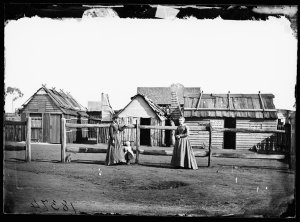
The bark hut doesn’t seem quite so isolated anymore, does it?
Which is probably neither here nor there in a discussion about a work of fiction like ‘The Drover’s Wife’ but which does speak to the way Henry Lawson’s life – and by extension his mother’s – has been mythologised.
In my biography of Louisa Lawson, I’m hoping to take some of those mythologies and hold them up to the light.
I’m aware that no biographer can ever really determine the full picture but perhaps I can use images like these to discover where there might be some interesting cracks in the usual story. As Leonard Cohen sings in Anthem “There is a crack, a crack in everything, that’s how the light gets in.”
I don’t remember seeing images of dead (white) men during the Vietnam War. But then, I look away. I do though have vivid images of body parts in the mud from reading about the Great War.
I surprised the Eurunderee house has a tin roof, but not that it’s a house. Without going back to check, I’m pretty sure the Drover’s Wife house is on stumps, ie. is not a hut with a dirt floor.
I look away too.
I’m actually not sure when that tin roof was installed – it’s on my list of things to find out. I’ve seen a drawing (by Charles Lawson) of that house but with a bark roof. And now I’ll also have to go back to ‘The Drover’s Wife’ to see about those stumps! I think you’re right – didn’t the snake get under the house?