Research Tips – Using a Timeline

The beginning of a research project often feels pretty chaotic. It’s hard to know where to begin and, once you’ve begun, it’s hard to know how to make sense of all the information.
I don’t have any magical solutions, but perhaps I can offer a few research tips.
I use a Word document to record my notes, because I’m familiar with Word and it makes my notes easily searchable. Some writers swear by Scrivener, but having used Word since the previous century, I’m too lazy to learn how to use a whole new word processing system.
I’m using Zotero to manage my bibliographic data because it’s free, and it makes inserting footnotes and endnotes almost effortless. This is the first project where I’ve used Zotero, so we’ll have to see how it goes. In the past I just used an Excel spreadsheet to record every book and article I used and frankly, that worked fine too. What’s crucial is the act of recording what you’ve looked at (and ideally as soon as you’ve looked at it) – not the way you record it.
One of the tools I’ve found most useful, though, is a timeline.
Again, I don’t use fancy software – I simply create a table in Word and start filling it in, adding a new row for each item.
First I add in all the easy-to-find biographical info. My subject’s birthdate. The date of her death. The date of her marriage, and the birth and death dates for her husband. The dates of birth for each of their children and, importantly, the dates of their deaths. If they predeceased her, for example, then that’s important to know when that grief struck, so I can begin to look for evidence of how it might have manifested.
I record the birth and death dates of her parents, and her siblings. Where large families are involved (and Louisa Lawson was the second eldest of twelve) some insights can be gleaned merely from these dates. Were her parents relatively young when Louisa was born? Did any of her siblings predecease her? Of those twelve children, when did the first son arrive?
The answer is at number eight, by which time Louisa was thirteen years old – old enough to see how pleased her parents were at his arrival, compared to the arrivals of her sisters. Even the way the children were named attest to this fact: all the girls were given a first name, some (not Louisa) were given a middle name, but that first boy was bestowed with a three names plus his last name. This is the sort of detail I find fascinating!
At this early stage in the research, nothing is too small or too large not to be included.
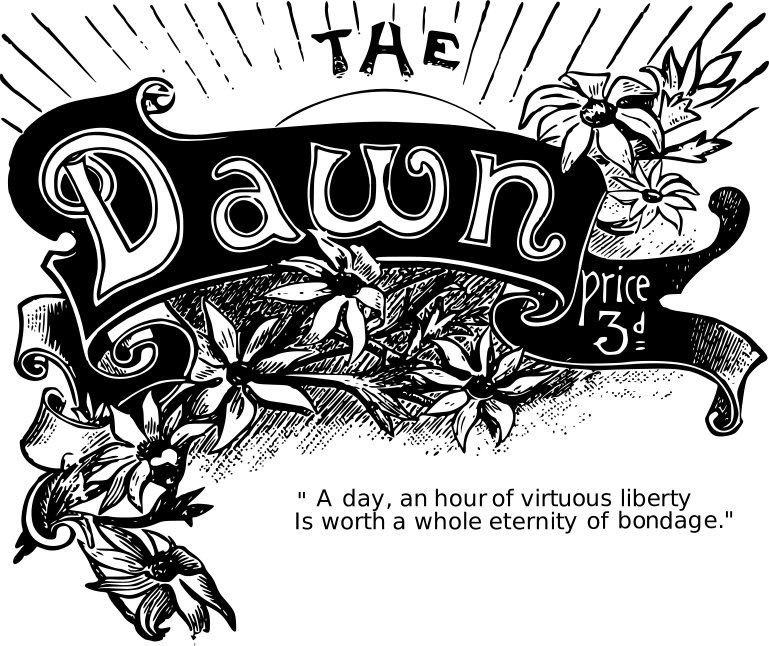 My timeline of course also includes the milestones of Louisa’s life, and those of her children. As I read the sources, each time I come across an event linked to a particular date, into the timeline it goes: Louisa lobbying in 1876 to establish a primary school near the family farm in Eurunderee; the May 1888 establishment of her newspaper The Dawn; her fall from a tram in 1900, in which she was seriously injured; her son Henry’s attempted suicide in December 1902.
I also include larger events of public interest, which may have impacted on Louisa’s life or outlook. The 1888 ‘Exhibition of Women’s Industries’ in Sydney; the Wyoming territorial legislature granting women the right to vote and to hold public office on 10 Dec 1869; and the economic depression of the 1890s.
As I read and research, very little of this information arrives in date order, but inserting it into my timeline helps me to better understand how things impacted on Louisa; helps me to know where she was at in her life when particular things occurred.
My timeline table has many rows, spreading over many pages but it only has four columns: date, notes, source and age.
Date is self-explanatory: where I have the full date (day, month, year) I include it but if not then the year will do. I can always update it later, as more information comes to hand. And each row in my timeline is listed in date order – I just add rows above or below existing entries as needed.
Notes usually include just a few lines about the activity being recorded. Sometimes my thoughts, more often I simply paste a sentence or two across from the source document. It’s not plagiarism – this isn’t the manuscript – I’m merely taking notes for research purposes, that I’ll refer back to once the writing begins. At which point I certainly will use my own words and interpretations.
Source is important. Here I include the name of the reference, or the web address, or whatever information future me will need to find my way back to the original material. I’ve learnt the hard way not to rely on memory!
Age is perhaps the most interesting. I use this (very narrow!) column to record Louisa’s age at the time of each recorded activity. I suppose I could just do the maths in my head, but this way I can see at a glance that she was a mere 19 years of age when Henry was born; 28 years old when she lobbied for that Eurunderee primary school; and 35 when she moved with her youngest children to Sydney.
One other thing I use the timeline for is to record when Louisa was pregnant. There’s not much science to it – I just count back nine months from the date of each birth. But then it becomes clear, for example, that she moved house when 6 months pregnant with her third child. To a biographer, that’s certainly worth knowing.
I created a similar timeline when I was working on my biography of Elizabeth Macarthur.
Through it, I was surprised to learn that at the time her husband was overthrowing the lawful government (you might know it as the Rum Rebellion of 1808), she was 42 years old and pregnant for the ninth time. It’s not something old-fashioned history books tended to mention! Elizabeth Macarthur’s last child had been born eight years previously, so the reality of this new baby was perhaps a bittersweet surprise.
The timeline also clearly demonstrated to me that the Macarthurs’ eldest daughter was, in January 1808, gravely ill – possibly with polio, or something similar – and no one was sure if she would survive. You may think these combined factors might have caused John Macarthur to pause in undertaking a momentously treasonous act, but then if you know John Macarthur at all you’ll be aware that pausing for thought was probably not in his nature.
This sort of familial context, and these kinds of insights, are truly a biographer’s delight.
Of course no one’s life is a neat timeline of events, actions and reactions. But I’ve found that creating a timeline helps me to make sense of the messy realities of a thoroughly-lived life, and offers me a structured way of managing the research information that I collect along the way.
Perhaps if you’re undertaking research about a particular person, you might find it useful too.
I don’t do much research, certainly not as much as you do, but I’ve done a lot of work on Miles Franklin in particular and I can see how a timeline would be useful, and how it would help to have an ‘age’ column. Of course, Jill Roe’s biography of MF, which is actually an encyclopaedia in date order came out just as I was finishing my thesis, and I have been able to use it ever since to confirm what was going on with MF in any given year.
But I might do a timeline of Daisy Bates. It would be interesting to see when she was doing stuff and at what age. (If I ever do a PhD, unlikely now, it will be on DB in WA).
You should absolutely do that PhD!
I use a timeline because it’s easy and flexible. Whenever I come across any interesting factoid, I can just drop it into the timeline – secure in the knowledge that I’ll be able to find again a months/years later when I actually need it. TBH I also have another doc where I save information by topic (under various sub-headings) but once I’m deep into the writing it’s the timeline that’s actually more useful.
The timeline also highlights correlations – that is, clearly person X did that thing because person Y was doing ABC at the same time. I’ve already discovered a really important and interesting one in Louisa’s case, but it’s been completely ignored (or unknown) by other writers.
I have a timeline for my bio of my music teacher Valda Johnstone (which isn’t ever going to get into print but I’m going to lodge it with the SLV). But mine is a bit chaotic, and has too much stuff in it. I like the orderliness of your system.
Some future biographer is going to be eternally grateful to you, no matter how chaotic it is! And there’s no such thing as too much stuff – some of it may actually be a vital clue.
Thank you Michelle, really interesting to read about your process. Timelines reveal so much. I tried Scrivener because everyone was raving about it, but I have returned to OneNote and Word, which have generally served me well. In OneNote I have Chronological, Thematic and People sections.
Hi Nathan – your sections seem like such a sensible way to arrange material. I’ve only glanced at One Note (at work, as it happens) but you’ve now convinced me to have another look at it!