Exploring Louisa Lawson’s Marrickville
Late last year I spent several delightful hours in the company of writer and historian, Sue Castrique, exploring Louisa Lawson’s Marrickville.
We’d not met before. But, hearing that I was writing a book about Louisa Lawson, Sue reached out to me online and kindly invited me to Marrickville, to learn more about the place where Louisa Lawson lived for the last 15 or so years of her life.
I can’t begin to tell you what a wonderful morning Sue gave me. We were two women who began the day as strangers but definitely ended as friends. Given our common interests, once we started talking, didn’t seem able to stop!
Sue met me at Sydenham Station and began by pointing out the shallow valley we stood in. She explained how the earliest housing developments – workers cottages built in the late 1800s out here on what was then the rural outskirts of Sydney, were constantly subject to flooding.
Then she drove me across to Mackey Park, a sports field wedged in the corner of Marrickville formed by the Cooks River and the railway line.
We hopped out of the car to sit beside the river – tide high, fish jumping – and reimagined the soccer field before us as the swampy wetland it once was. Part of the traditional lands of the Gadigal peoples and possibly (as swamps are for many other First Nations peoples) a particularly important place for women, and women’s business.
Sue traced the lines of creeks for me, now buried in the stormwater system. From a sheaf of papers in her bag she produced a treasury of photos, paintings, maps, and title deeds.
We looked up the hill to where a mansion, a rich pastoralist’s folly, had once stood.
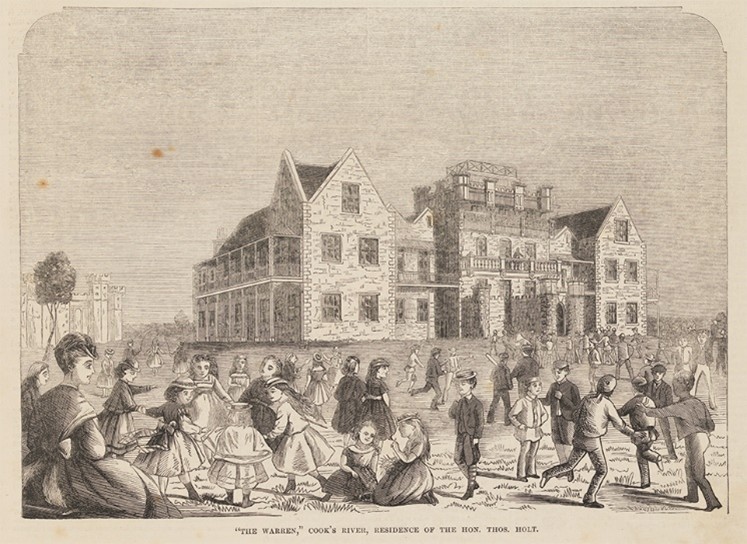
Now the hill is covered with suburban houses, old and new, but ‘The Warren’ had been a Victorian Gothic declaration of wealth with over 30 rooms, filled with art and sculptures. Even the stables were built of sandstone quarried on the property.
‘The Warren’ was the heart of a grazing empire consisting of millions of acres, and it had its own gatehouse down on the river flats, a small but solid bluestone cottage about 500 metres away as the crow flies.
Thomas Holt, the rich pastoralist who built the mansion, left the colony in 1881 and in 1884 ‘The Warren’ was subdivided. Carmelite Nuns bought the mansion and a surrounding 12 acres (5 hectares) but they failed to pay their debts and in 1922 the then derelict mansion was demolished, with the land used to provide housing for returned soldiers.
Sue took me to where the house used to stand.
All that remains today is a quiet suburban thoroughfare called Mansion Street, and a small grassy park containing two castellated pillars salvaged from the front of ‘The Warren’, now incongruously standing sentinel over nothing at all.
All the power of that place – and it was substantial – emanated not from the ridiculous pillars but from a natural rock formation providing a perfect lookout point across the river, over the former wetlands and eastward towards the coast. Shaded by a magnificent fig it seemed obvious that the lookout rock had, for thousands of years, been an important place to the Gadigal. I hope it still is.
But it was the mansion’s bluestone gatehouse cottage that Sue and I were really interested in.
In 1901 Louisa Lawson would buy that stone cottage and in 1905 at the age of 58 – after quitting her newspaper The Dawn and leaving central Sydney – she moved in and lived there until a year or so before her death, in 1920.

By 1905 the Old Stone Cottage, as it was called, was bordered on one side by a row of worker’s cottages, and on the other by the railway line. A large, open concrete drain – an attempt to reduce flooding in the area – also ran between the cottage and the train line.
Located right at the end of Renwick Street, the cottage was on a larger block than the nearby cottages, leaving room for fruit trees and a substantial garden. Behind the cottage, wetlands and seasonal lagoons led down to the Cooks River, only a couple of hundred metres away.
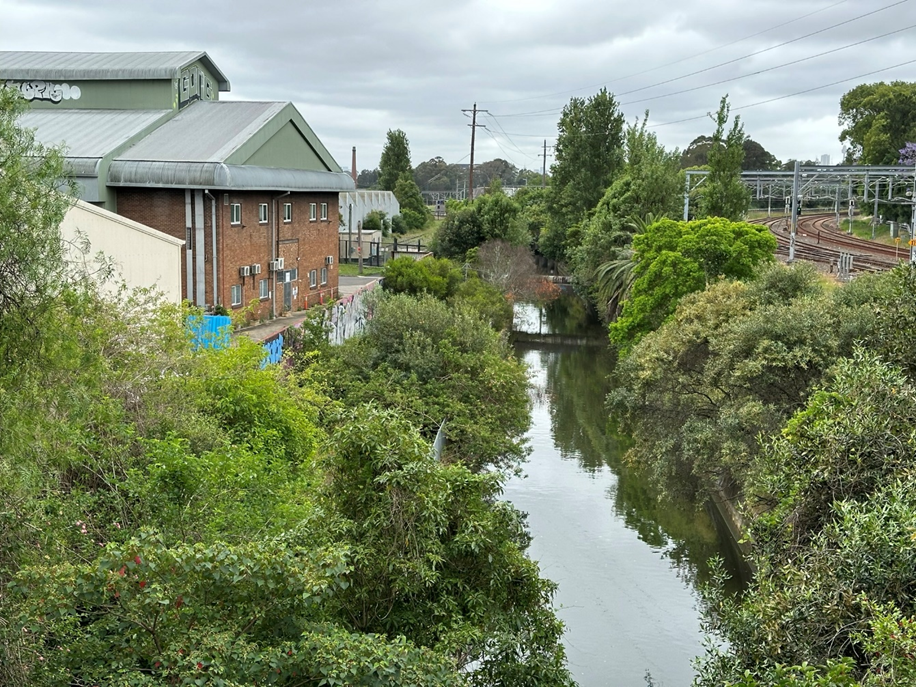
Tackling the Richardson Crescent road bridge on foot, Sue and I looked down into the drain and, to our left, onto what had been the back of Louisa’s property.
The drain, once a wonder of engineering, has become an overgrown, liminal place, lined with wild-sown exotic trees (privet, peppercorn, a date palm festooned with roosting ibis). It’s beautiful, in its own wild way.
Then we walked around the block to easternmost end of Renwick Street.
It’s mainly lined with industrial workshops. A hive of small businesses crammed between the railway line, the drain, suburban houses and a busy road. The street veers a little to the south at its very end, tracing the ghostly outline of Louisa’s front boundary.
But there’s no trace of Lawson’s cottage now. The short lane, or driveway, that once led to her cottage on its almost half an acre is long gone, under the concrete. And a poorly matched pair of warehouses – one of them a graveyard for taxis – entirely cover her property.
As Sue and I stood on the footpath peering at the warehouses, a diffident, kindly man on a forklift drove up to see if we were OK. Dark beard, a friendly smile, and an accent that hinted at countries far from here. We’re historians, we said, a famous woman used to live here. He nodded and then proceeded to tell us about the history of this place, this suburb – his place, now.
It was wonderful.
He spoke about the floods, and the river. He told us about convicts, hinted at lunatics and speculated about ghosts and bushrangers.
Then he wished us well and, needing to get on with his work, drove away in his forklift.
Sue and I spent the rest of our morning speculating too. We talked and talked, swapping theories and ideas about how and who and why.
When Louisa Lawson lived in the Old Stone Cottage it was still very much on the urban fringe, in open countryside. Sue was taken by how similar that countryside was to the country around Mudgee, where Louisa was born and lived until she was 35.
From her cottage in Marrickville Louisa had direct access, across the wetlands, to the Cooks River and thus to the fish, ducks and eels that lived there. She had fruit trees, and a vegetable garden – all of which, Sue and I thought, helped to put food on her table when her savings were so meagre.
“She was poor,” remembers one of her neighbours, then a working class child. “Poorer than us.”
The Old Stone Cottage may look pretty to modern eyes but it certainly lacked indoor sanitation and probably didn’t have running water. Every cooked meal relied on a wood-burning fire – we’re not even sure if a stove was installed. The Board of Health had raised concerns about the property during Louisa’s tenure and the Lawson family sold the cottage after her death, to BHP By-products Pty Ltd, which established a tar distillery on the site. The cottage seems to have been demolished in the 1950s or 60s.
Finally, Sue took me up the hill again, to the opposite end of Renwick Street, where it crosses Illawarra Road and becomes Harnett Avenue. There we visited another little park – this one dedicated to Louisa Lawson.
At the entrance to the park is a low stone wall, built (according to the plaque) with blocks salvaged from the Old Stone Cottage. And in the centre of the park is a beautiful mural depicting, in blue and pink and gold, the front cover of The Dawn.

That was wonderful too.
In fact the whole expedition was a wonderful, precious gift – helping me to walk where Louisa walked, and showing me the place, the landscape, where she lived.
I’m deeply grateful to Sue Castrique for reaching out to me and generously sharing her deep, insightful and fascinating knowledge of Marrickville, and of the Old Stone Cottage.
The Marrickville Library is planning to stage a Walk and Talk in May 2025, comprising an evening talk by me about Louisa Lawson and then, the following morning, a walk around the relevant Marrickville locations with Sue and me together. Join us in exploring Louisa Lawson’s Marrickville. Details coming soon – stay tuned!
In the meantime, try these sites if you’d like to know more about:
- ‘The Warren’
- Thomas Holt
- Sue Castrique’s writing about Louisa Lawson in Marrickville
- Sue Castrique’s wonderful, haunting essay about Marrickville pre and post white settlement in Griffith Review Online
Sue Castrique is a historian and script writer who lives in Marrickville. She is the author of Under the Colony’s Eye: Gentlemen and Convicts on Cockatoo Island (Anchor Books Australia, 2014), which was awarded the Kay Daniels prize by the Australian Historical Australia, and One Small World: The History of Addison Road Community Centre (2017), funded by Inner West Council. She has also worked extensively in historical documentaries for the screen.
Comments