Louisa Lawson’s Poetry – poignant, if not perfect
 These days novels are considered the cream of the literary crop.
Think about it.
The best known writers in Australia are, with rare exceptions, novelists. Not the best-selling, mind you but certainly the most revered, the most beloved. (Best-selling celebrity cook book authors, I doffs me hat as you progress, laughing, all the way to the bank.)
At the end of the nineteenth century though, it was poets.
Of course people still loved novels (Louisa Lawson read Robinson Crusoe and the works of Dickens to her children), but poetry held pride of place in the Australian literary heart. Newspapers and journals included poems as a matter of course.
Back then Australia’s best and most beloved writers – like Henry Lawson or Banjo Paterson – were revered for their poetry much more than for their prose. And I think I know why.
It’s also partly because Lawson’s and Paterson’s use of rural vernacular sparked a flash of recognition in their readers. Perhaps for the first time, readers saw themselves and the people they knew speaking in a familiar way, right there on the page, larger than life. Poems about daffodils blooming in the northern spring were all very well, but verses about the vagaries of cattle and drought and expert horsemen spoke to colonial readers in a very specific way.
And finally, I think it’s also partly because their poems fitted neatly into an oral tradition which, even as their poetry appeared in print, was already on its way out.
Colonial literacy levels rose from 58% in 1861 to 80% in 1901. The contributory factor was compulsory schooling, first introduced in Western Australia in 1871 with the other states following soon after.
Yet illiterate bush workers like Henry Albury, Henry Lawson’s maternal grandfather, could recite many dozens of poems from memory. That’s what poems were originally for, after all: an aide to memory and oral story telling. Lawson’s and Paterson’s ballads, with their cantering rhythms and regular rhyming schemes, were perfect for an evening performance at the fireside.
Someone who could recite poetry well was highly valued. Someone who could write it well, even more so.
“Father is a born poet,” said Louisa Lawson, referring to Henry Albury in an 1896 newspaper interview. “They tell me I take after him.”
Well, perhaps she did – at least in intent. Louisa’s love of poetry began in childhood and remained for her whole life.
At school her education, according to her great-granddaughter, included “the great classics of literature, both prose and verse.” She early on discovered ‘native’ poetry, about Australia, and was such a fan of the work of Henry Kendall that, while still struggling to support her own family, she singlehandedly launched a fund-raising campaign to provide an appropriately grand monument for his grave.
Not just an avid reader, Louisa was a keen writer of poetry too.
Some, she would later note, “were composed before leaving school, and others with babe at nurse.” She didn’t see her work in print though, until she was thirty years old, when in 1878 her local paper, the Mudgee Independent, published ‘My Nettie’, a poignant short piece about the death of her infant daughter. The final verse (of three):
Ere faded the flowers we place on her breast
Her soul must have reached its bright haven of rest
And ever I pray that my portion may be
Where baby – my baby is waiting for me.
Her surviving daughter Gertie (Nettie’s twin sister) would in adulthood recall that her eldest brother Henry “had the task of writing and rewriting [‘My Nettie’] to her dictation. I have had the same task scores of times and hated it. She was very painstaking, as poetry did not come easy to her, and she worked very hard to make this poem as perfect as possible. I suppose Henry would have to copy it at least a dozen times before it would have been completed.”
Strangely, I’m yet to find even one of Henry Lawson’s biographers mentioning Gertie’s comment in any detail. Apparently they’re not interested in discussing how Henry, in childhood, began learning to write poetry by transcribing his mother’s dictation while she composed her verses.
 A comparative study of Louisa’s handwritten drafts against subsequent typescripts and published works has shown Gertie to be right: her mother was a consistent and conscientious improver of her poetry. Although it must be said that Louisa was habitually unconcerned about regular spelling in her manuscript drafts, which frequently lack any punctuation at all. These elements were left to be “corrected” at typing or typesetting stage.
During her 40s and 50s, Louisa Lawson’s poetry was published in a range of Australian journals (sometimes under a pseudonym) and even internationally. Louisa also, of course, published many of her own poems in her newspaper, the Dawn.
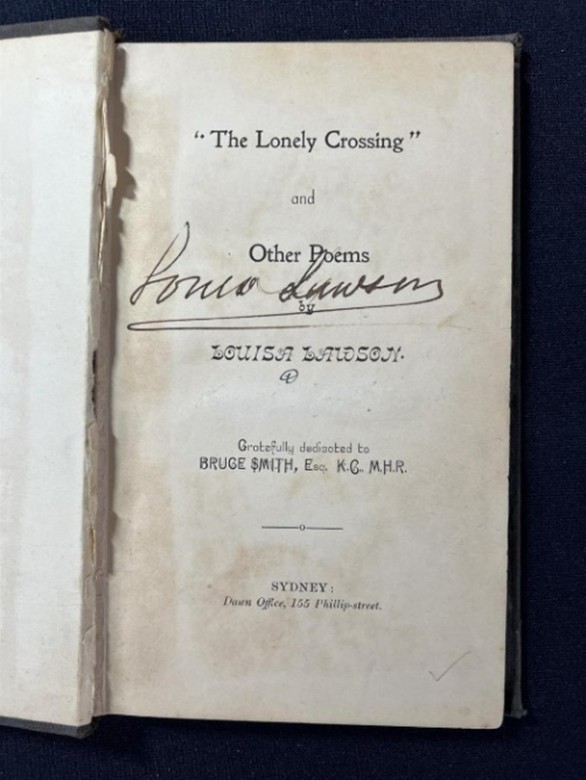
Finally, in 1905, aged 57, Lawson self-published a poetry collection in a slim volume called The Lonely Crossing, to mixed reviews. The Bulletin described it as “a little book of primitive verse: but keenly felt and sometimes adequately expressed.” Thankfully other reviews were kinder!
Earlier this year an original edition of The Lonely Crossing, signed by Louisa and containing some corrections in her own hand, was passed in at auction – the asking price was $1500-$2000.
To be fair, Louisa Lawson’s poetry can be sentimental, without complexity and, mostly, without subtlety. Their quality is inconsistent and they’ve been judged, generally, to lack literary merit.
But they were indelibly informed by her first-hand experience and – this was unusual for the period – they are almost always written from the feminine point of view. Through her poems she also expresses compassion, concern, sympathy and love of her country, and love of nature. They are valuable today because of what they tell us about her.
In total, 155 of her poems remain, collected in a terrific but admittedly hard-to-find volume called Louisa Lawson: Collected Poems with Selected Critical Commentaries edited by Leonie Rutherford and Megan Roughley with Nigel Spence (the State Library of NSW has a copy, if you’re keen).
One of my favourites, ‘They are Taking the Old Piano’ is transcribed below. It was published in the Sydney Mail in June 1906, although the editor there omitted the final stanza. It’s interesting to wonder why.
For me the power of this poem lies less in the quality of the writing and more in the emotions it evokes, and the multi-layered scene and historical moment that it captures – when a piano was as crucial a household fixture as the television screen is today and there was no Age Pension available. Maybe you’ll like it too.
They are taking the old piano,
They are lifting it from the floor,
To carry to the waggon,
That stands at the old home door.
And mother is mutely watching,
With tears on her faded cheek,
I wonder of what she’s thinking;
Her heart is too full to speak.
Perhaps of the day he brought her,
While out from the roseate arch,
There rang from the old piano
Bright strains of the “Bridal March.”
Or may be when long years after,
It wailed the “Dead March in Saul”
As slowly he went forever,
Enwrapped in a funeral pall.
I know by her pain drawn features,
How tightly the chords entwine,
I know that the empty corner
To her is a ruined shrine.
We’re selling the old piano,
We’re selling to buy us bread,
And keep for a little longer,
The old roof over her head.
To find out more about Louisa Lawson’s poetry:
- The poems of Henry Kendall https://allpoetry.com/Henry-Kendall
- All three verses of ‘My Nettie’ by Louisa Lawson https://www.australianculture.org/my-nettie-louisa-lawson-1905/
- An online version of Louisa Lawson’s self-published poetry collection The Lonely Crossing, including all the poems in that volume https://www.australianculture.org/the-lonely-crossing-louisa-lawson-1905/
I struggle to read poetry and especially sentimental poetry, but somehow I made my way to the end. I like the story about Henry transcribing for Louisa. Bertha (his wife) tells of transcribing and retranscribing for Henry as he attempted to get right the rhythm of a ballad.
So interesting (and typical) that Henry made Bertha do the thing he loathed doing for someone else …